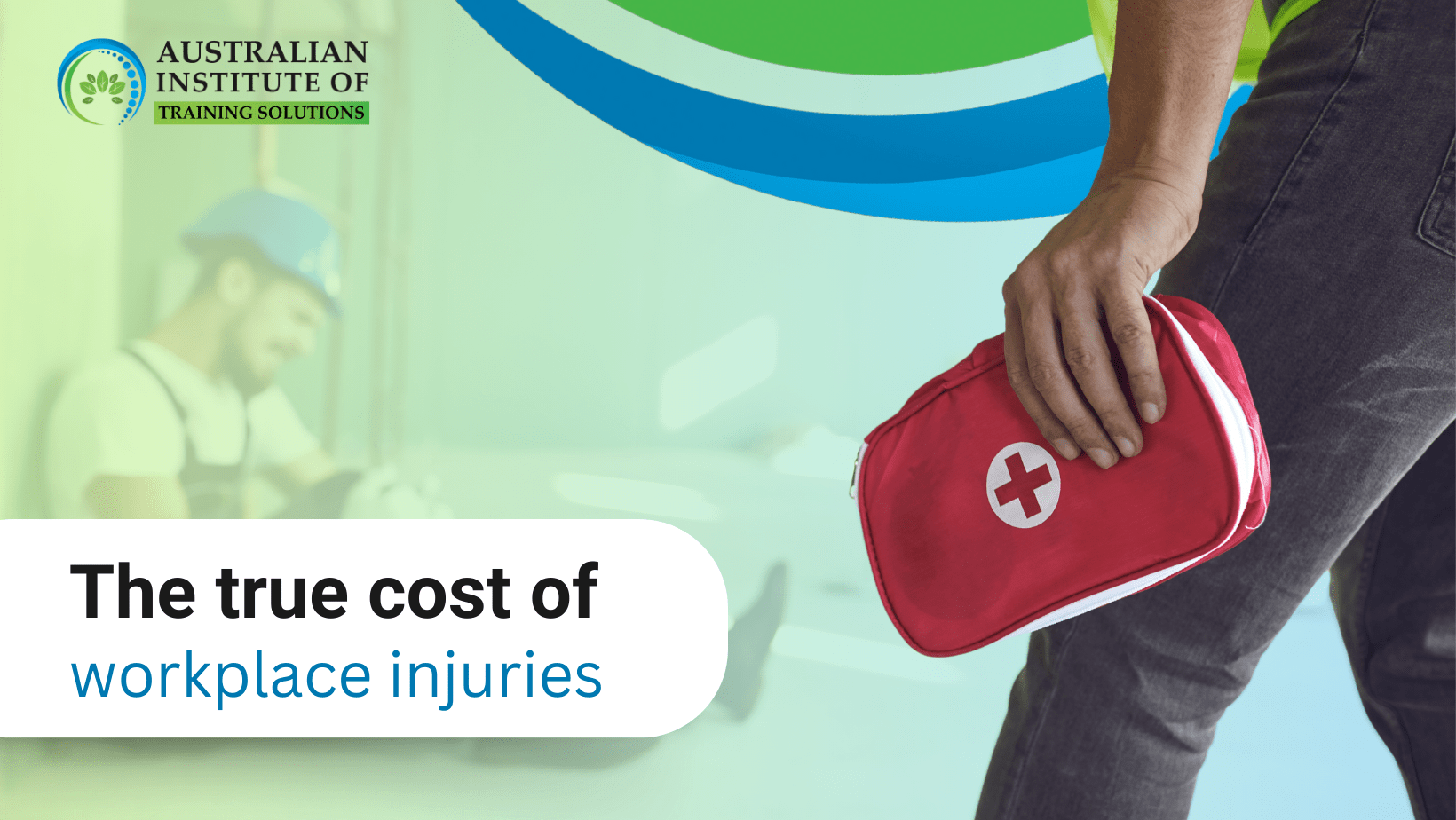
Do you know how much a lack of emergency preparedness could cost your business long-term?
If an accident or incident occurs in your workplace, there is always potential for it to lead to a workers compensation claim (depending on the nature and severity of the injury).
Thankfully, the right treatment with timely intervention can prevent costly claims by minimising exacerbation of injuries, and even save lives:
- For every minute without CPR, survival rates decrease by 7–10%, which is why having CPR training is so critical.
- If a heart attack occurs and blood flow isn’t restored quickly, this can lead to the death of heart muscle and tissue, causing irreversible damage.
- It takes as little as 4 minutes for someone to pass away from an obstructed airway or choking incident.
Accidents and emergencies are not 100% preventable, but measures can be taken to reduce long-term damage (and ongoing expenses) by ensuring your team are keeping their First Aid and CPR Training current each year.
Consider the following four implications that can arise from a worker’s compensation case:
1) Time lost to administrative paperwork
When an employee goes for workers compensation, there’s a lot of documentation and paperwork that the employer must provide and submit.
This takes both you and your team away from business operations and higher priorities, so it makes sense to reduce the number of workers compensation claims you have to manage by ensuring employees have their First Aid and CPR Training.
Example A
Irreversible damage can occur if blood flow isn’t restored quickly enough following cardiac arrest, which can be done by performing CPR immediately. In the case of Andrea Morris, CPR began 7 minutes too late, resulting in a permanent disability.
While this is an American case, the Australian Workers Compensation Act 1987 stipulates that compensation for heart attacks is payable if the nature of your employment significantly increases the risk of a cardiac event.
Being a nurse, Andrea Morris would be considered eligible and may have been more likely to receive compensation of up to $500,000 or more under Australian law.
That’s why it certainly pays to have your CPR training, and our HTLAID009 Provide CPR course only sets you back $45 per person (P.S: get in touch today to organise a reduced price for a group booking!)
2) Increased premiums
Your premium is calculated based on factors such as:
- Industry risk
- Employee payroll
- Claims history
- Safety programs
Those working in higher risk industries such as construction, healthcare, mining and transportation are at risk of higher premiums if they encounter frequent or high-cost claims.
In fact, construction consistently ranks as having the highest number of Australian workers’ compensation claims per year.
In addition to this, high-risk workplaces legally require one first aider for every 25 workers and failing to meet this requirement puts you at risk for a $3M non-compliance penalty.
Since larger payrolls typically lead to higher premiums, this is the last thing any workplace needs.
In most cases, your premium will increase every time a workers compensation claim is made, so it pays to do everything in your power to reduce unnecessary claims made.
3) Productivity loss
An injured worker typically leads to temporary or permanent loss of the injured worker’s contributions to the business, which causes a whole different scope of problems.
While workers compensation does cover medical expenses, lost wages, rehabilitation, and other benefits for injured workers, you are not exempt from the costs associated with finding a replacement.
There is hiring and training to consider, and a potential loss of quality and efficiency while the replacement gets up to speed (or simply holds the fort until the injured worker can return to work).
Example B
Dylan Holmes had clocked in to his shift at a manufacturing facility when he suffered a sudden, cardiac arrest on duty. His colleagues immediately performed CPR and used an Automated External Defibrillator (AED), which was credited by paramedics to be the reason he’s still alive today.
His story reinforces the importance of having trained First Aiders on site. Their knowledge and fast response to the situation not only saved their colleagues’ life, but protected the business from any costly, negligence-related cases.
Our HTLAID011 Provide First Aid course equips your team with the life-saving skills to provide life-saving First Aid in emergencies. Get in touch today to organise a reduced price for a group booking!
4) Financial strain
There are additional complications that can add financial strain to a workers compensation case, including the legal fees associated with the investigation, as well as how the company’s reputation might be impacted (affecting client trust and incoming revenue).
Keep your staff’s First Aid training up to date
The points covered in this article are all great reasons to ensure your staff is keeping their First Aid and CPR Training current.
Maintaining First Aid training can help your entire team stay confident and knowledgeable for any emergency situation.
To remain compliant, nominated First Aiders must renew their CPR Training (HLTAID009 Provide CPR only) every 12 months, and their First Aid and CPR Training (HLTAID011 Provide First Aid and CPR) every 3 years.
Not to mention, if your company is growing quickly, you may need to nominate more First Aiders to avoid risking a $3M non-compliance penalty.
If you’re ready to book First Aid for your team, organise a corporate or group booking which allows a full group to renew their training through our half day certification (we’ll come to you!)
Contact AITS today to learn more or book your course online!